Guest posts vs niche edits: which is safer for adult sites?
Guest posts versus niche edits: one adds a new article, the other adds a link to an old one. How each works, the point where each becomes a link scheme, and when an edit is perfectly fair.
By the AuthorityReachUK research desk · 6 minute read ·
Inside: The short answer · Side by side · Where both become schemes · When a niche edit is fair · Warning signs in a niche edit offer · What we use, and when
The short answer
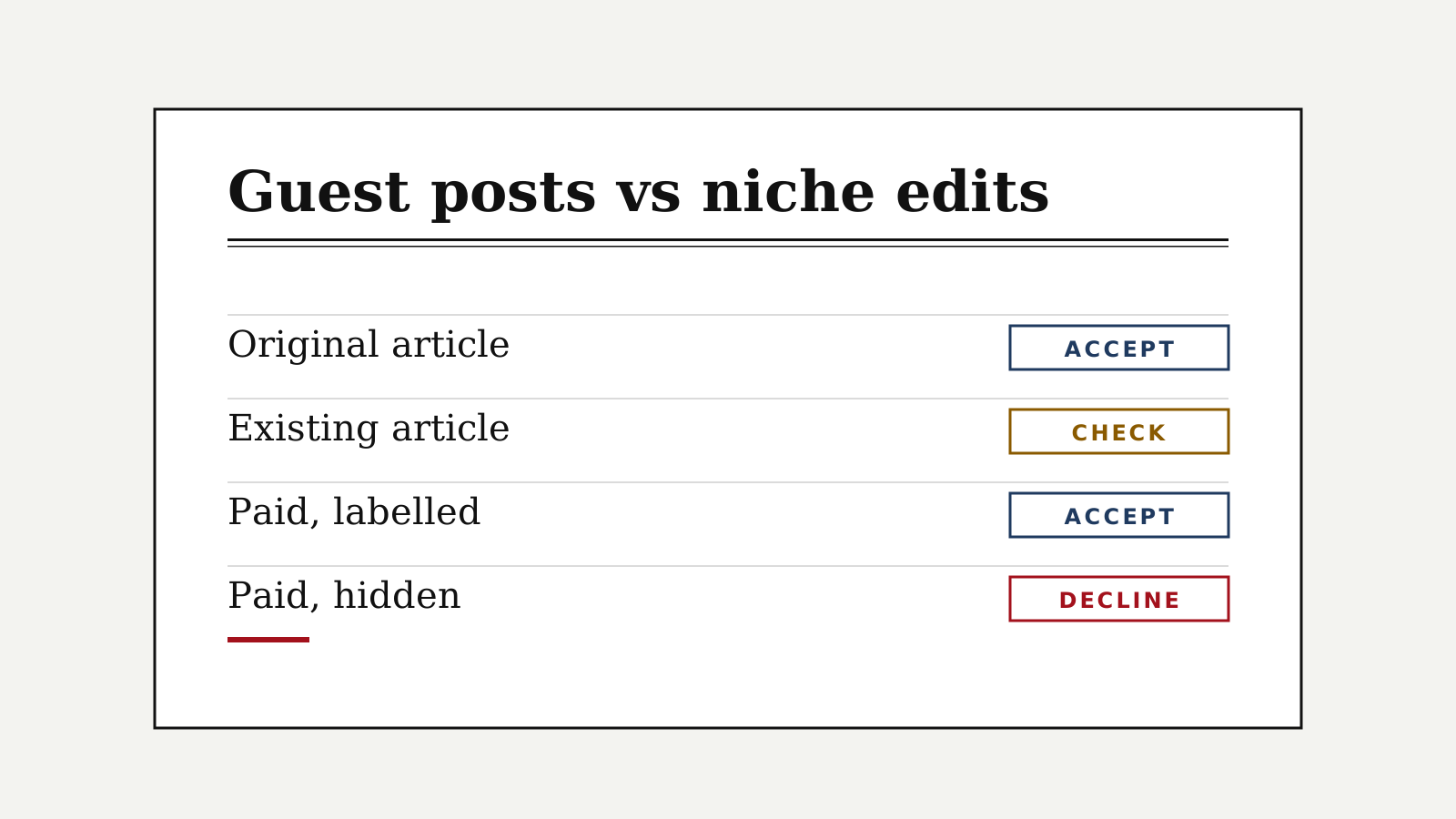
A guest post adds a new article to someone else's site. A niche edit adds a link to an article that already exists there. Neither is safe or unsafe by name. Both become link schemes1 in the same way: when money buys a link that passes ranking credit without a label. And both can be perfectly fair, when the content helps readers and anything paid is marked as sponsored.
Side by side
| Question | Guest post | Niche edit |
|---|---|---|
| What changes on the site | A new article appears | A link appears in an old article |
| Who writes the words | You, or a writer for you | The publisher, originally |
| Why sellers like it | Easy to scale across many sites | Old pages often have links and traffic already |
| Main risk | Keyword anchors and articles written only for the link | A link that does not fit the article, added for payment |
| Fair version | An original, useful article with an honest byline | An editor adding a citation because it improves the piece |
Where both become schemes
Google's spam policies1 do not care about the format. They name buying or selling links that pass ranking credit, paid articles with links that pass ranking credit, and optimised anchor text in articles or guest posts distributed on other sites. The same policies say paid links are fine when they carry a nofollow or sponsored attribute.
So the test is the same for both formats: was money or a favour exchanged, and if so, is the link labelled? If there was no payment, is the link there because it helps the reader?
When a niche edit is fair
Publishers update old articles all the time: new data, a better source, a broken link replaced. If your page genuinely improves an existing article, asking an editor to consider it is ordinary outreach. The fair version looks like this:
- The article is on your subject, and your page adds something it lacked, such as data, a guide or a source.
- The editor decides, and can say no.
- Nothing is paid, or if it is, the link is labelled and marked sponsored.
- The anchor is natural: the name of the resource or your brand, not a keyword.
Warning signs in a niche edit offer
A price list of "aged posts with traffic", a guarantee that the link will stay forever, a promise that there is "no sponsored tag", an article on an unrelated topic, or a seller who is not the site's editor. Each one suggests the link is for sale to anyone, which is what makes it worthless.
The same checks apply as for any link, set out in our backlink quality checklist. The anchor itself matters too, as covered in anchor text strategy.
What we use, and when
We use guest articles where a brand has real expertise to share, and editorial update requests where a client has a resource that genuinely improves an existing page. Paid placements, in either form, are labelled and marked sponsored, and every one appears in the client's ledger.
How we handle guest content is set out on adult guest posts, and the wider standard on adult link building.
Readers ask
Q. What is a niche edit?
A. A link added to an article that is already published, often an older page with some search traffic. It is also called a link insertion or a curated link.
Q. Are niche edits against Google's rules?
A. Paying for a link that passes ranking credit is a link scheme, whether it sits in a new article or an old one. A paid insertion is acceptable when it is labelled and marked rel="sponsored"; an unpaid editorial update is fine.
Q. Which works better for rankings?
A. Neither, as a category. A relevant link from a real publication helps; an irrelevant one does not, however it was placed. Judge each opportunity with the same quality checks.